Small game - birds
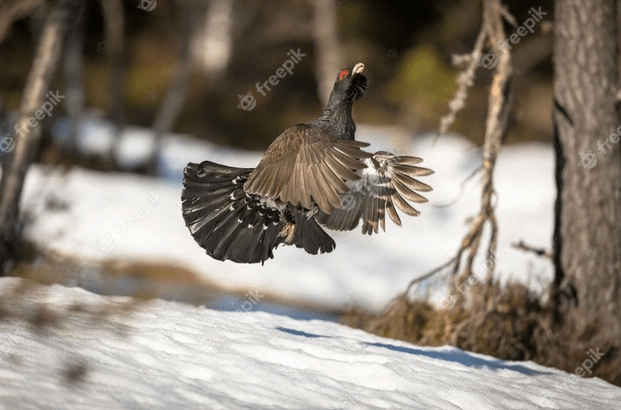
Dandelion (Tetrao urogallus)
• Men's – April 15 through May 15
A large bird, about the size of a turkey. The male is almost entirely black, with a white bill, red patches of skin above the eyes, and white at the base of the wings. The female is mottled, camouflage-colored, and smaller. The young birds are similar in color to the female. It takes off sharply and strongly, but flies poorly, which sometimes causes it to hit a stem or branch of a tree and suffer. The breeding season begins in March, and then the male chooses a suitable clearing where he molts. It arrives in the area at dusk and makes several calls from the branch it will be sleeping on to announce its presence. In the morning, he begins the weaving itself, which he does either from a tree branch or perched on a stump. From time to time he walks around the moulting area where the females congregate, which is between 50 and 100 meters in diameter. At times it is so focused on the ritual that it stops paying attention to the sounds and movements around it and becomes easy prey for predators and hunters, because of this it was long thought that it deafens and this "deafness" gave the name to the species. When the moulting period reaches its peak, the male can moult almost until the evening. The grouse is a polygamous bird and the male does not take any care of the young, during moulting he sometimes covers up to 3 females in one morning. The females then withdraw and prepare their nest. It lays up to 10 whitish-yellow eggs, very similar to hens. The nest is on the ground and is a shallow hole covered with twigs and feathers. The female moults so persistently that she can easily become a victim of a fallen tree or a predator, such as a goshawk, wolf or wild boar. In the first days after hatching, most of the young die for a variety of reasons. As with other birds of the family, the young hatch well developed and very soon begin to walk and feed on their own.
You can hunt -
at: